1 MIN READ
Switching
Why small businesses switch bank accounts. And why most never finish the move.
Field data from 300+ switching conversations with US small business owners, paired with the published research on where SMB banking is headed.

Daniel West

1,400+
Businesses reached across three pilots
300+
Switching conversations logged
Days 0–7
The window that decides the relationship
Field data from 300+ switching conversations with US small business owners, gathered while helping them migrate income, payroll, spend, vendors, and clients to a new business bank account. Paired with the published research on where SMB banking is headed.
Intent to switch is at a high. Completed switches lag far behind. [[Market context]]
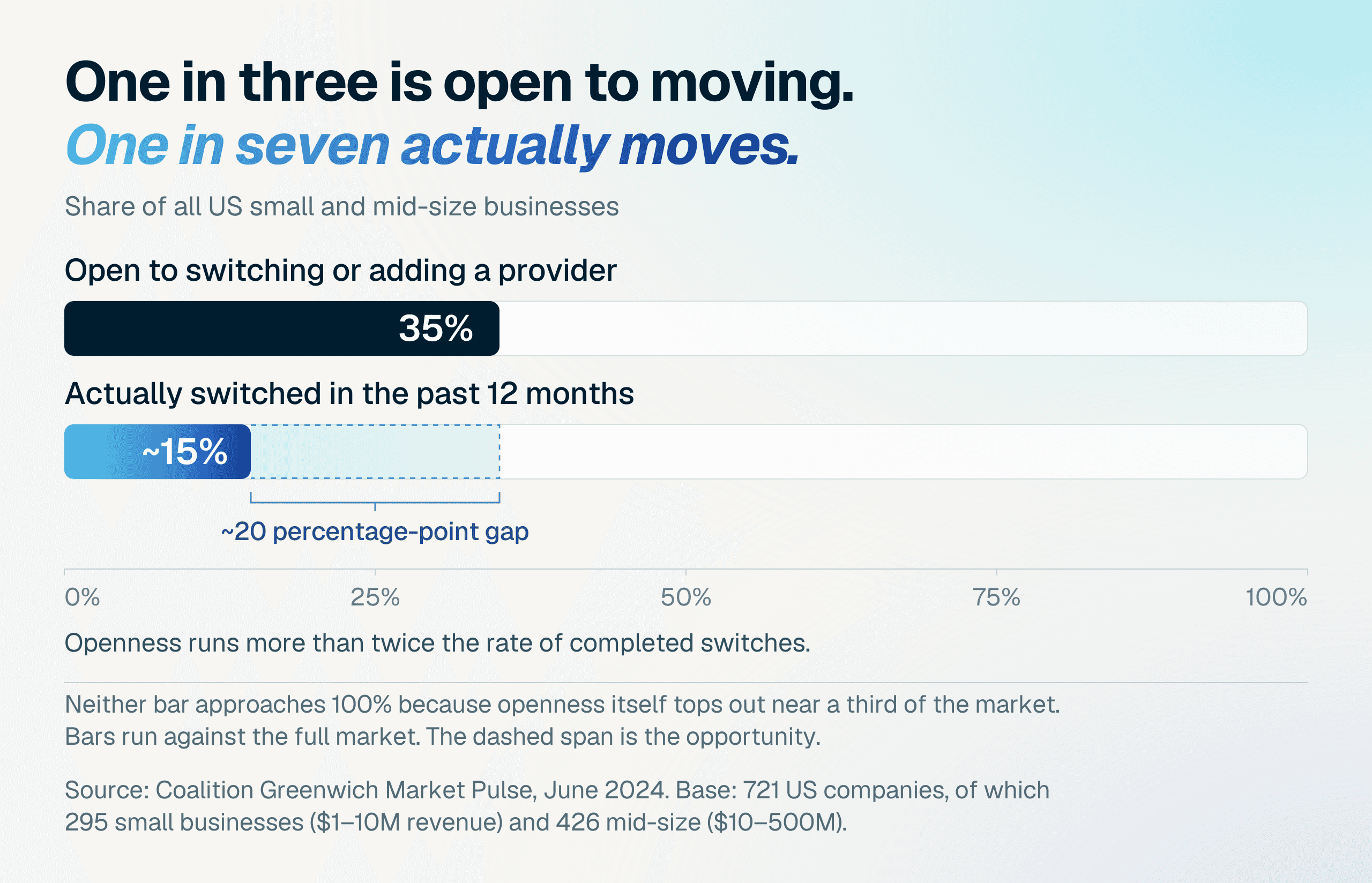
Small business banking is unusually contestable right now. Coalition Greenwich found that 35% of US small and mid-size businesses are open to switching providers, and that roughly 15% changed banks in the past year, well above the historical norm of about 1 in 10.¹
The pressure is structural. After the 2023 bank failures, Cornerstone Advisors reported that 7 in 10 SMBs now hold 2 or more deposit accounts, up from fewer than half in early 2020, and that over half opened a new checking account or card in a single 14-month stretch.² The average small business juggles 5–8 financial providers.³
Yet openness rarely becomes movement. YouGov found 58% of account holders skip switching because it feels like too much hassle.⁴ Consumer Reports found that of those who considered switching, over half were blocked from following through, largely by the work of rerouting deposits and automatic payments, a process Consumers Union clocked at 4–6 weeks.⁵
The prize for whoever closes that gap is primacy. Curinos data shows a primary business relationship drives roughly 8x the fee revenue, 10x the deposit balances, and 7x the operating deposits of a non-primary one.⁶ Over half of SMBs define their primary institution simply as the place their deposits land.⁷ And banks themselves estimate that only about 55% of their active accounts see them as primary.⁸
So the industry has a funnel problem hiding in plain sight. Accounts get opened. Relationships stall. The published research tells you the gap exists. It says little about what is happening inside it.
That is the question this report answers. Over the past year, our team sat with hundreds of small business owners, on the phone and on screen shares, and physically helped them move their financial lives from one account to another. What follows is what they told us, and what made them move.
Three pilots. One method: do the switch by hand, and write down everything. [[Methodology]]
In early 2025, InstaSwitch ran structured switching pilots with three business banking platforms. In each one, our team personally called recently opened, underfunded, and unfunded accounts, asked owners why they signed up and why they stalled, and then helped willing owners migrate income, payroll, spend, vendors, and clients, step by step. Along the way, we wrote step-by-step switching guides for the payroll, invoicing, and payment tools those owners run on, and verified every step live.
Cohort | Partner profile | Owners reached out to | Switching conversations |
|---|---|---|---|
Pilot A | Vertical SMB banking platform | 633 owners (400 calls + 404 emails) | 66 |
Pilot B | Digital business bank, revenue-source activation | 475 owners (~850 calls + 330 emails) | 68 |
Pilot C | Small business banking platform | 350 owners | 64 |
The left column is how many owners we contacted. The right column is how many of those became a real conversation about switching. Every number in this report comes from those call logs, session notes, and balance records, or from the published sources listed at the end. Partner platforms, industry verticals, businesses, and owners have been anonymized throughout. Across all of the anonymized data, the patterns are clear.
Finding 1: Owner intent is already sitting in the account base. [[Finding 1: Intent exists]]
The unactivated accounts on a platform’s books look like dead leads. Most of them already hold the owner’s intent. What they are missing is guidance.
Across the pilots, a majority of the owners we reached had already decided, at least in principle, to make the new account their operating home. In Pilot C, 58.6% of owners said the account is or will be their primary business account. In Pilot B, that figure hit 81% among engaged owners.
That intent does not convert on its own. Something or someone has to push it along. Roughly half of the switching sessions we held produced a completed switch, and 67% of the owners who booked a session went on to make incremental deposits, whether or not the session itself ever happened. Booking was the high-intent signal. Left alone, the same owners kept not moving.
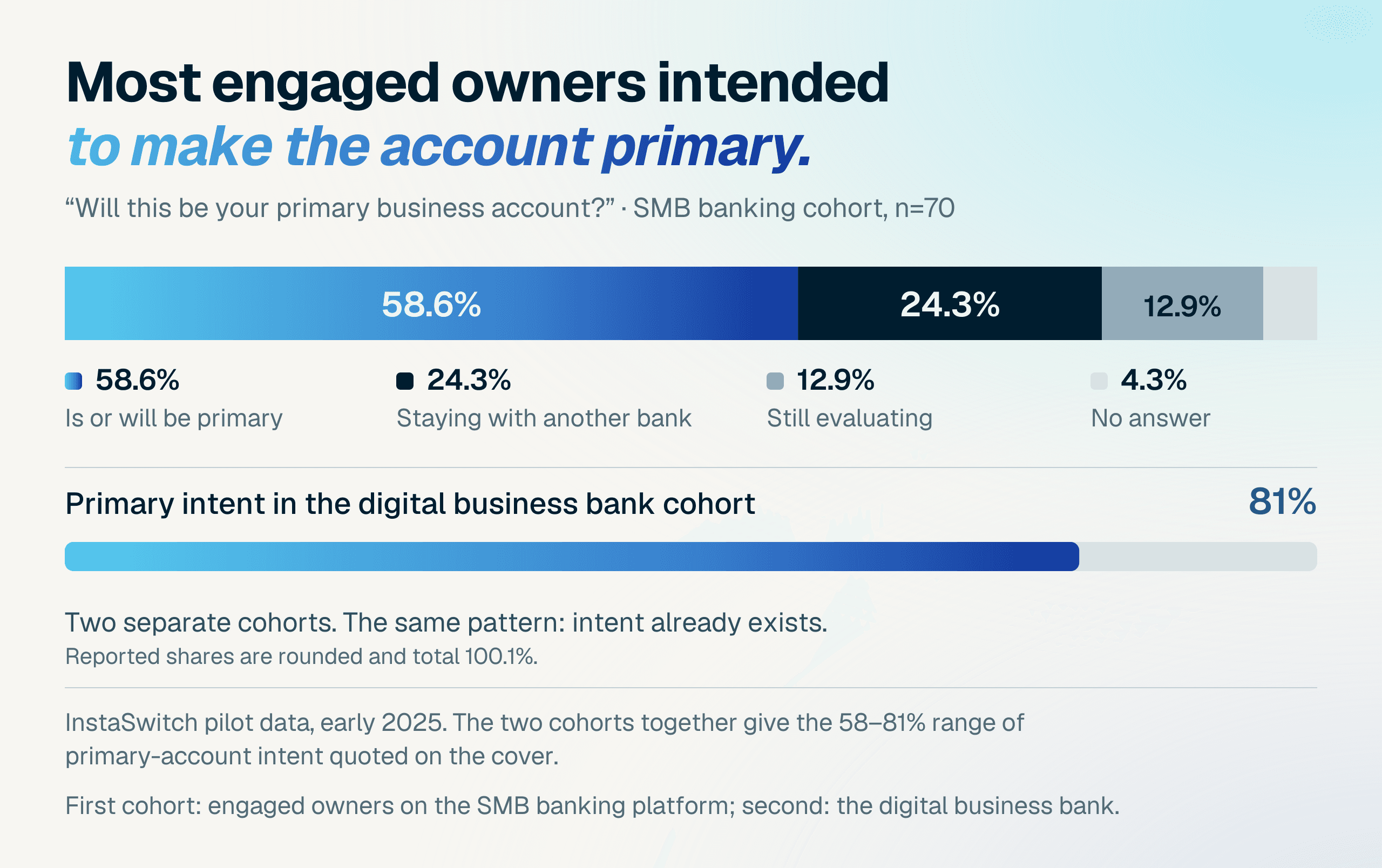
Signal | Engaged owners who said the account is or will be their primary business account | 58.6% |
Signal | Primary-account intent among engaged owners, digital business bank cohort | 81% |
Convert | Held switching sessions that produced a completed switch | ~50% |
The takeaway. The deposits you are chasing are already signed up. Unactivated accounts are not dead leads. The intent is there, and it needs guidance to convert.
Finding 2: The barrier is bandwidth. Willingness was rarely the problem. [[Finding 2: Bandwidth]]
Ask why an account sat empty and the answer is almost never “we chose against you.” It is “we’re taking care of customers, trying to make payroll, and there is no free Tuesday.” Time and complexity together explained 36–53% of stalled switches, depending on the cohort. Owners are running businesses, often trying to survive the week. Rewiring the plumbing under those businesses keeps losing to everything else on the list.
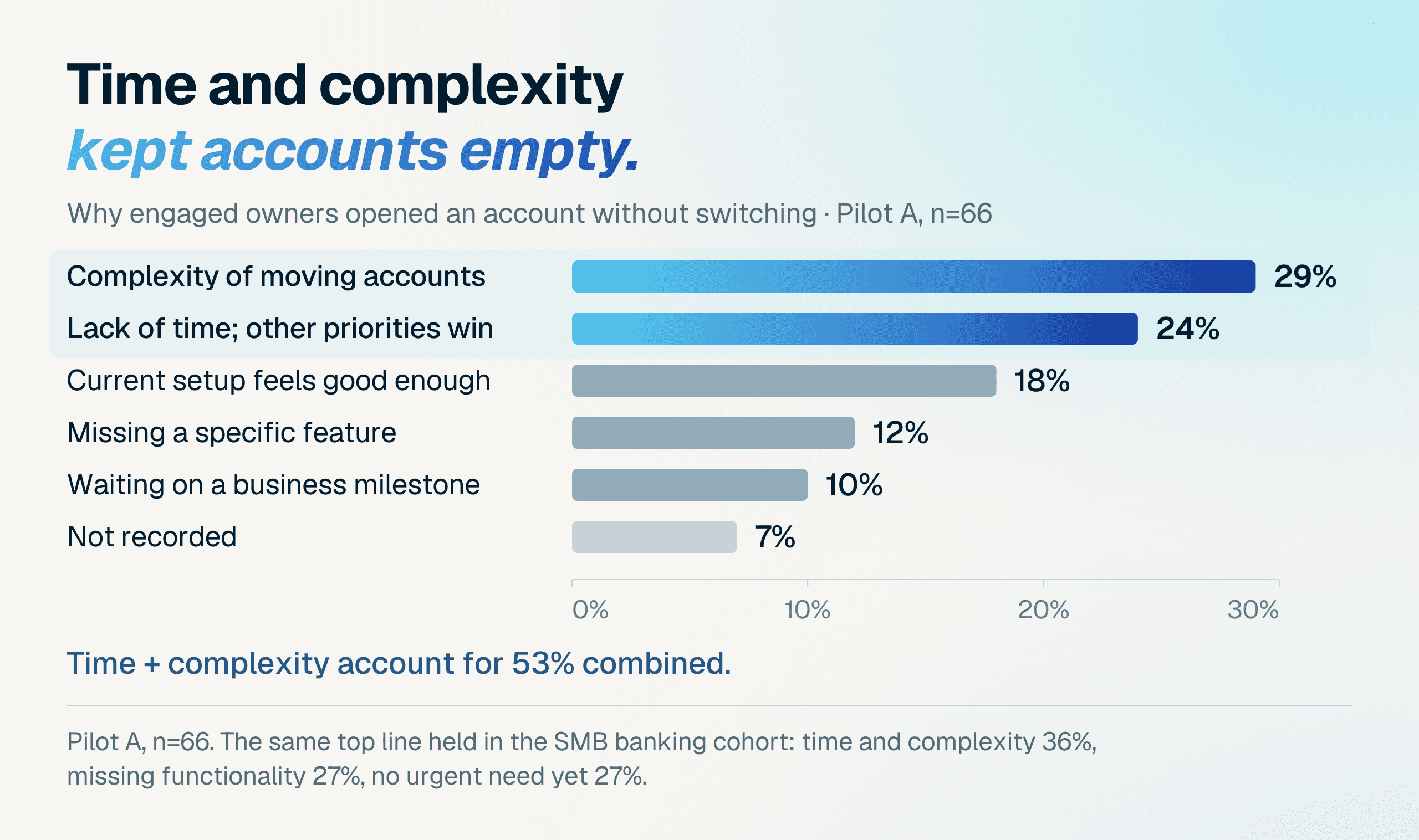
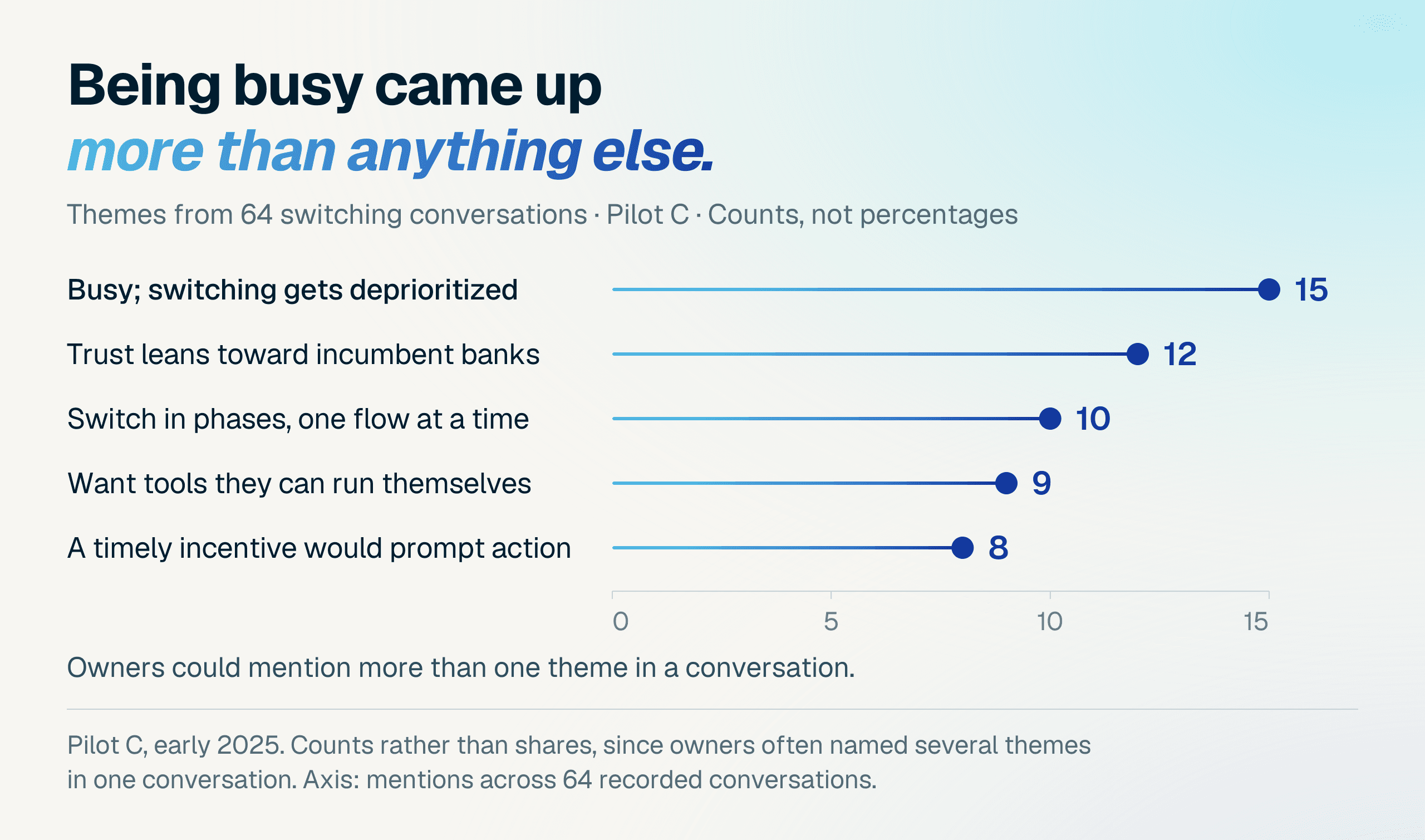
Two nuances matter inside those bars. First, “good enough” is a friction statement in disguise. Owners who said their current bank works fine almost always followed it with a version of “and moving everything feels like a project.” Second, the fear is operational. The single most common worry was breaking something mid-move: a missed vendor payment, a payroll run landing in the wrong account, a customer’s autopay bouncing. When we mapped the exact steps and sequenced them, that fear dissolved on the call.
Pilot field note
On why owners quit mid-migration
When a user thinks about everything they need to move, they can feel hesitation and overwhelm and abandon the switch.
The overwhelm also starts before execution does. Most owners could not name everything that needed to move in the first place, so the switch stayed an unscoped project rather than a task. The abandonment risk is measurable: 38% of owners who found the platform overwhelming told us they would have walked away entirely without someone stepping in.
The takeaway. Structure the move for them. When owners do not have to scope the switch and build the plan before executing it, the complexity stops being theirs to carry, and they finish on their own time.
Finding 3: Switching is a sequence. [[Finding 3: The sequence]]
Owners migrated in a consistent order: fund the account, point income at it, then payroll once income lands correctly, then spend, vendors, and payees. A minority finished one-and-done, in a single sitting, and never looked back. Most moved in phases, and wanted a schedule, a plan, and proof at each step before trusting the next one.
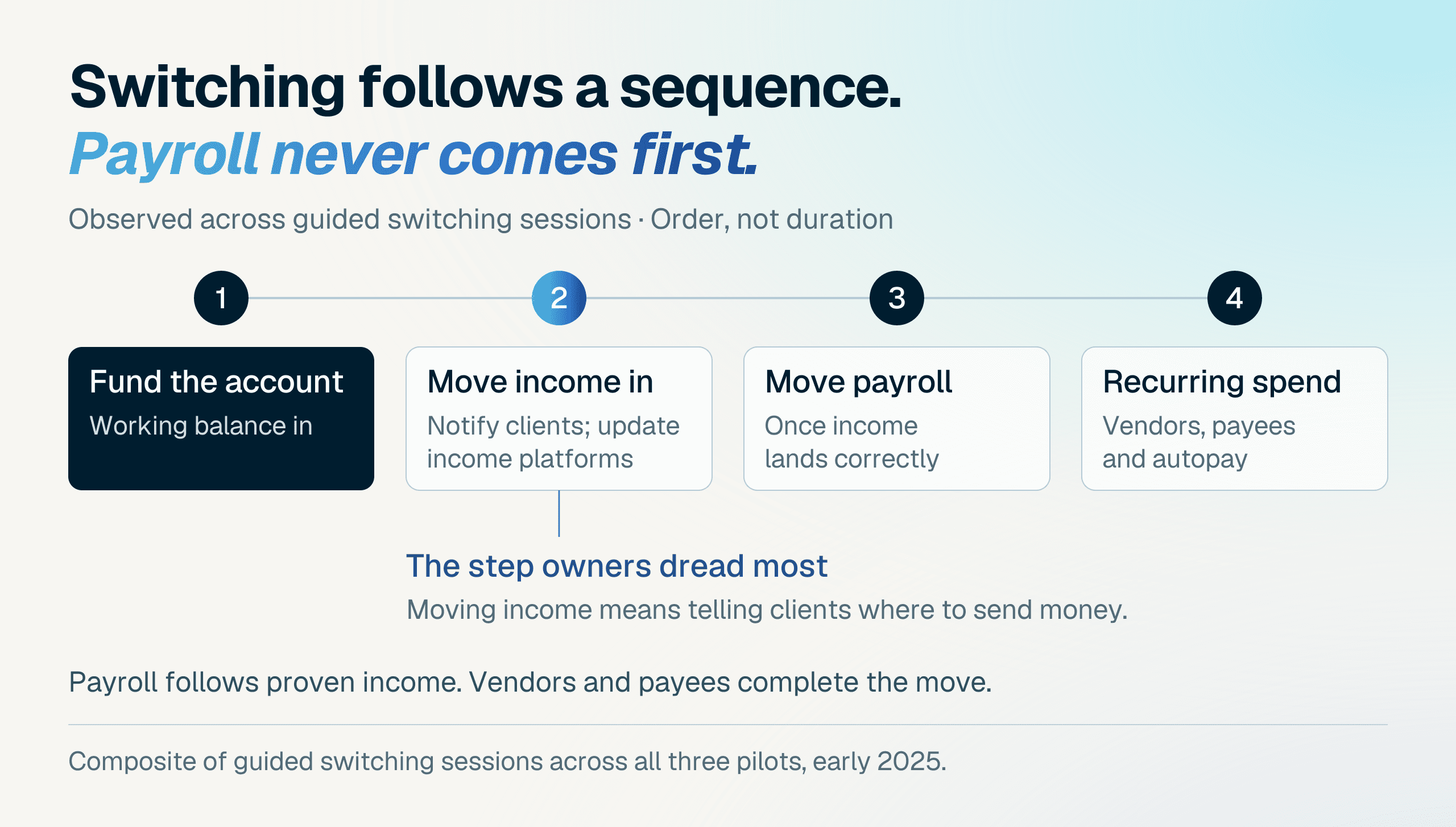
Moving income is the critical flow, and it is the step owners dread most, because it means telling clients where to send money. Payroll follows only after owners have watched a few deposits land correctly; no one risks a pay run on an account they have not seen work. The spend side comes last, and its long tail is payees: vendors, contractors, rent, utilities, and the dozen autopays nobody remembers setting up.
Archetype one: One-and-done switchers
Complete the whole transition in a single sitting and never think about it again. Example from our sessions: a tax services firm moved payroll and payments off a national bank in one guided session, influencing $90K in money movement, including a $30K weekly payroll run in steady state.
Archetype two: Planners
Work through a longer checklist over weeks, want a schedule, and need proof at each stage before extending trust. Example: a home services company moved income first, then payroll, then recurring spend. Initial impact was $13K in deposits, with over $1M in annual revenue set to route through the new account.
The takeaway. Income in first, payroll once it lands right, then spend, vendors, and payees. Serve the one-and-done switchers a single flow, give the planners a schedule, and make sure every partial switch has a natural next step.
Finding 4: The switching window closes fast. [[Finding 4: The 7-day window]]
Momentum is the scarcest resource in a switch. In the vertical SMB banking cohort, 65% of the owners who took action had signed up within the previous 60 days. But the real story sits inside that window: the accounts that became primary were the ones that got moving in the first 7 days.
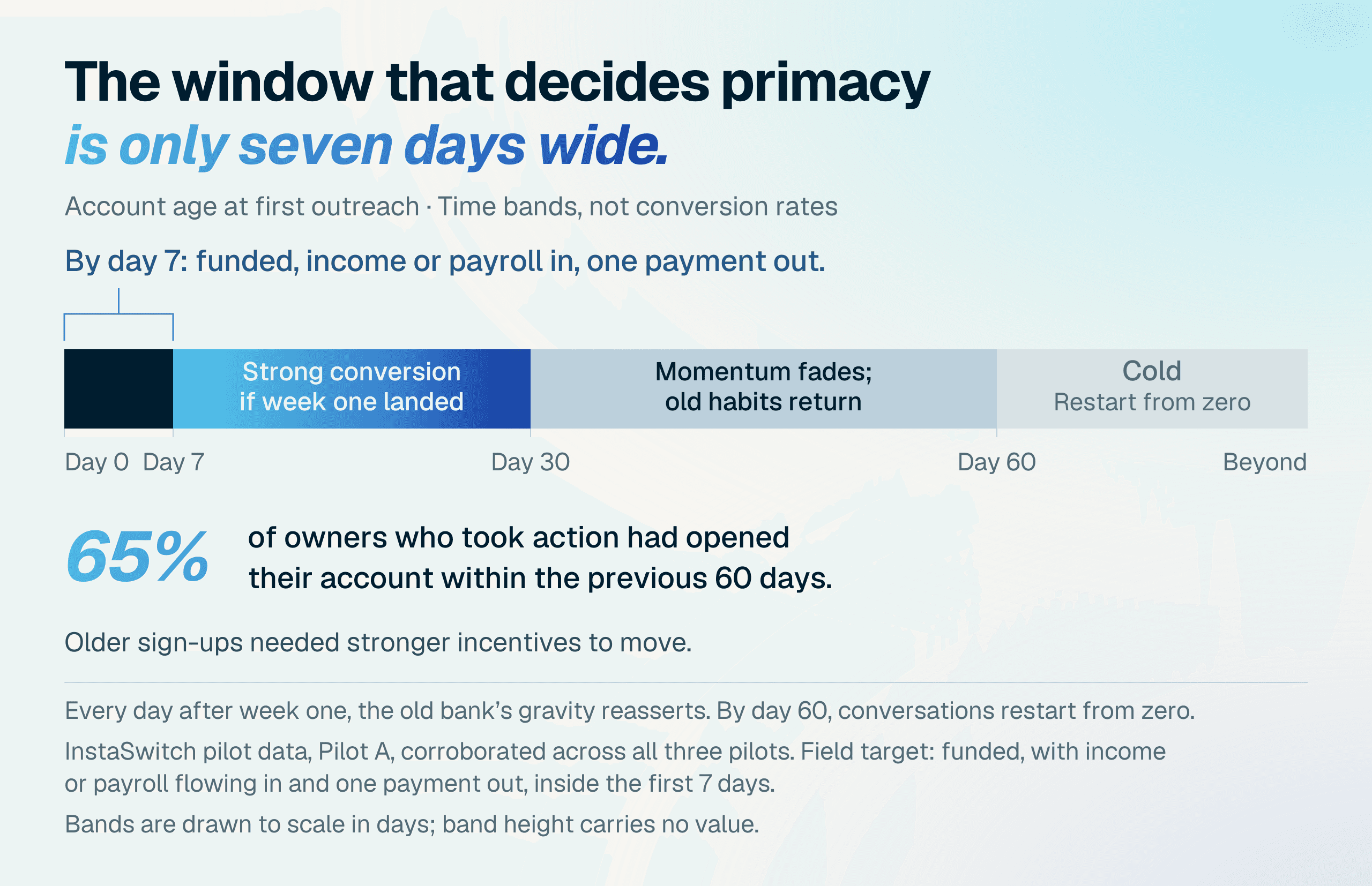
The first week carries the energy of the decision itself. An owner who just opened an account is still in motion: the reasons are fresh, the login is new, the old bank’s shortcomings are top of mind. Every day after, the old bank’s gravity reasserts. By day 60, habits have re-formed around the incumbent, and every conversation starts over from zero.
The recipe inside that window is specific. The accounts that reached primacy shared a day-7 pattern: a working balance in the account, income or payroll flowing in, and at least one payment out for real operational activity. Once money moves in and out, the account is the business’s operating home. The primacy game is established before day 30, and usually inside the first week. Lose that week to another account, and you stop being the default and become the disruption.
The published research rhymes with this. J.D. Power found that 61% of small businesses that applied for a loan considered switching banks, and Rivel finds that switching decisions cluster around moments of change.⁹ ¹⁰ Our data shows what those moments look like for a business: landing a first big client, winning a contract, launching the online store, hiring the first employee, opening a second location. In Pilot B, 24% of stalled owners were simply businesses that had yet to launch. They had opened the account in preparation. The right play there is patience plus pre-wiring: connect account details to the tools before revenue exists, so day one of the business is day one of the relationship.
The takeaway. Primacy is decided in the first 7 days: funded, income or payroll flowing in, and one payment out. Win that week and the relationship follows.
Finding 5: Owners want the map, and they want to drive. [[Finding 5: Self-serve]]
Guided, human help proved intent exists. It also proved white glove cannot be the delivery model. Owners booked meetings readily, then struggled to show up in front of a computer at the appointed hour. What they asked for, over and over, was a way to do it themselves, on their own schedule, with the steps laid out.
Signal | Owners who said they would have switched sooner with an in-product, self-serve path | ~50% |
Signal | Lift in completed switches when simple self-serve guides were introduced | +30% |
Cost | Average live talk time to complete 10 switches in a pilot | 9.89 hrs |
Convert | Owners who booked a meeting and went on to make incremental deposits | 67% |
The economics are stark. 10 completed switches in a pilot took 9.89 hours of live talk time on average. The answer owners kept describing is a hybrid: transaction visibility that shows exactly what needs to move, a checklist that sequences it, and a link they can open at 9pm on a Tuesday. Human help on standby for the moments that need it.
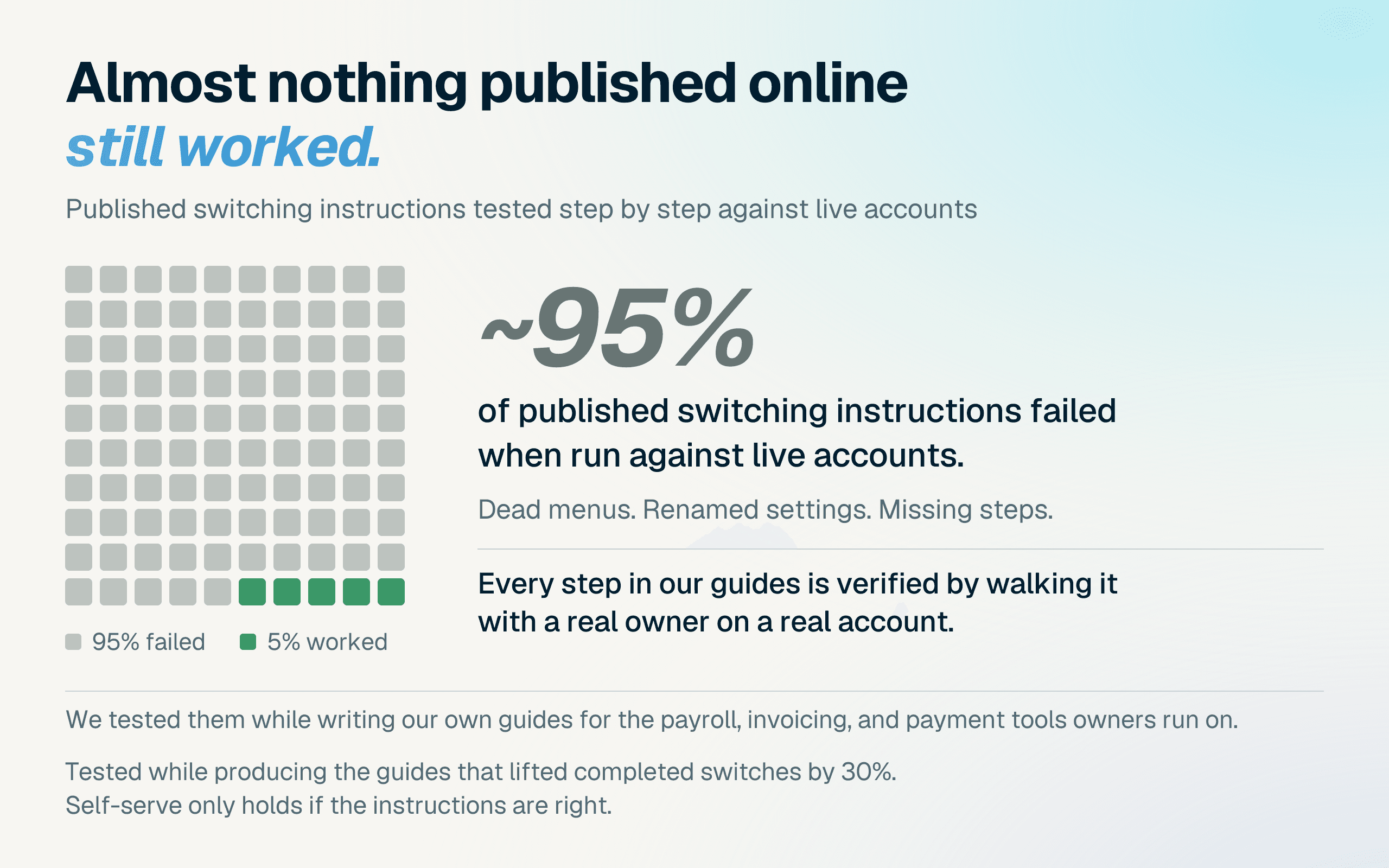
So we built the self-serve layer by hand first. We wrote switching guides for the payroll, invoicing, and payment tools owners run on, and tested the instructions already published on the open web along the way. Roughly 95% of that information was wrong or outdated: dead menus, renamed settings, steps that no longer exist. Getting the guides right is why they worked, and simple guides alone lifted completed switches by 30%.
The takeaway. Give owners the map and let them drive. Surface self-serve flows as the default, verify every guide, and offer human support where it is needed.
A playbook for anyone who wants funded, primary relationships. [[The playbook]]
The pattern across 300+ switching conversations reduces to five moves. Each one is checkable against the data above.
P1. Treat the first 7 days like a launch, because it is one.
The window is real, and momentum measurably decays after day 30. Instrument days 0–7 around one goal: funded, with income or payroll flowing in and one payment out. Primacy follows from that first proof.
P2. Show owners their own financial map before asking them to move it.
Overwhelm is the top abandonment driver. Ingesting transaction data and turning it into a personal checklist (these 3 income sources, this payroll run, these 5 autopays) converts a scary project into a sequence of 10-minute tasks.
P3. Sequence the migration: income in, then payroll, then recurring spend.
Match the phased behavior owners already exhibit. Payroll moves once owners watch income land correctly, and the spend side ends with vendors and payees. Celebrate each completed phase, and design the product so a partial switch has a natural next step instead of a dead end.
P4. Make self-serve the default and humans the escalation path.
Roughly 50% of owners said an in-product path would have moved them sooner, and simple guides alone lifted completions 30%. Ship the link, the checklist, and the verified guides. Reserve live help for complex, high-balance moves, where roughly 50% of held sessions convert. For phase movers, build in-product flows with reminders and prompts to update the next piece of operational activity.
P5. Time the nudge to the moment, and speak in the owner’s nouns.
Business milestones beat calendar campaigns. “Move your payroll” beats “connect your financial apps.” Small, deadline-bound incentives (“switch by Friday”) gave stalled owners a reason to act now.
Account opening is not the win. The primary relationship is. [[The bottom line]]
Every stat in this report points at the same conclusion. The market is full of businesses that have already chosen a better operating account and simply never finished moving in. The institutions that win the next decade of SMB deposits will be the ones that treat switching as a product surface: visible, sequenced, self-serve, and timed to the moment the business is ready.
For us, this research stopped being a report a long time ago. The sequences, the verified guides, the financial map, and the day-7 window became the foundation of the switching experience InstaSwitch ships today. Owners now run the same playbook these conversations proved, as product.
About InstaSwitch. InstaSwitch is the infrastructure that powers business bank switching. We help banks and fintechs convert newly opened business accounts into funded, primary relationships by automating the migration of income, payroll, spend, vendors, and clients. Before writing a line of software, our team completed 300 business account switches by hand, over 3,000 hours of doing things that don’t scale, and this report is built from what those hours taught us. To talk about the data or get started building switching infrastructure for end users, reach out to daniel@instaswitch.co
Methodology and anonymization. Pilot figures are drawn from InstaSwitch call logs, guided session notes, and partner balance records across three pilots conducted in early 2025 with US business banking platforms. Partner platforms, industry verticals, businesses, and individuals have been anonymized throughout. Percentages describe the engaged conversation cohorts stated in each figure and should be read as directional field research rather than a probability sample of all US SMBs.
Published sources
Coalition Greenwich, Market Pulse: “More Small Businesses and Mid-Size Companies in the U.S. Consider Switching Banks,” August 2024.
Cornerstone Advisors research on SMB banking behavior following the March 2023 bank failures, as reported by Gusto Embedded, 2024.
BAI Banking Strategies, “Recapture SMB growth by thinking like a fintech,” 2025.
YouGov CASH tracker, current account switching sentiment.
Consumer Reports National Research Center switching survey; Consumers Union, “Trapped at the Bank,” on the 4–6 week payment rerouting process.
Curinos primacy analysis (fee revenue, deposit balances, operating deposits), as reported by Lendio, 2024.
Alkami Technology, on how SMBs define the primary financial institution relationship, 2022.
The Financial Brand / Digital Banking Report survey of financial institutions on account primacy, 2025.
J.D. Power U.S. Small Business Banking Satisfaction Study (switching rates among fast-growing businesses; loan applicants considering a switch).
Rivel Banking Research, on switching vulnerability and life-event timing, 2025.
© 2026 InstaSwitch · New York · The infrastructure that powers business bank switching · v1.3 · Public edition