5 MIN READ
Company
The next ten years of business banking will be won on activation
Why opening more accounts won't fix the deposit problem, and what business banks should be measuring instead.

Daniel West
Today we're launching InstaSwitch, the infrastructure that helps business banks turn opened accounts into active ones. We've raised $4.7M in seed funding led by Chicago Ventures, with participation from 8-Bit Capital, continued investment from Better Tomorrow Ventures, Panache Ventures, and executives from Unit, Square, PayPal, and Plaid.
The activation gap
Approximately 5.4 million U.S. small businesses attempt to switch banks every year. Most never finish.
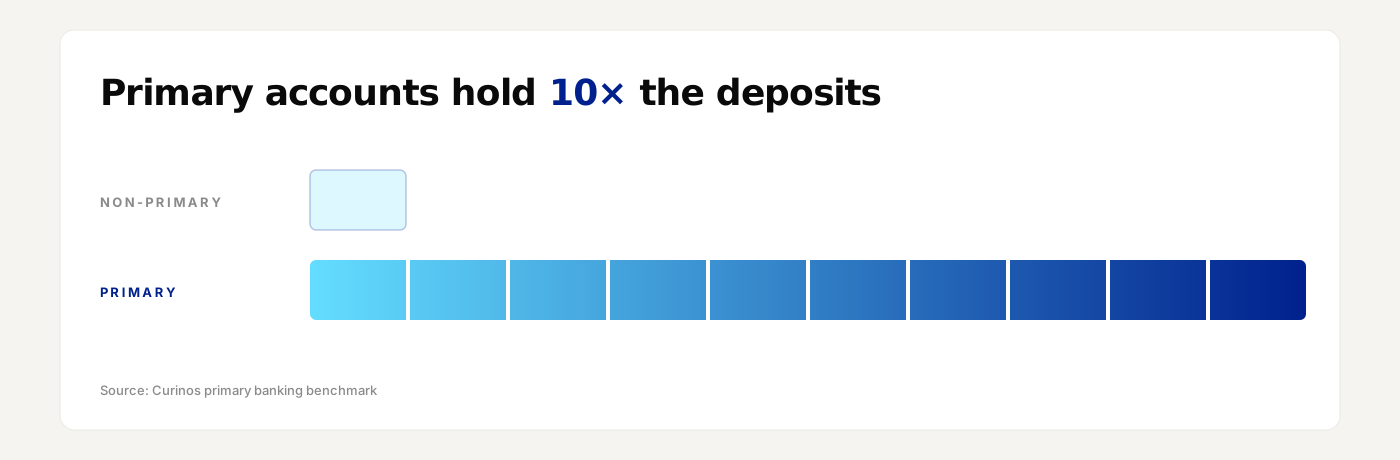
Curinos data shows primary customers hold 10x more deposits than non-primary customers. The difference is whether income, payroll, and spend actually moves. For most institutions, they don't.
An account opens, a test deposit lands, and then everything stalls. Income keeps landing at the old bank. Payroll keeps running out of it. Vendors keep getting paid from the old account. Six months later, the institution has a name in the system, the cost of acquisition on the books, and a customer who never became one.
Every financial institution lists deposit growth as their number one or two priority. Competition for SMB operating accounts has never been tougher. Business platforms are securing bank charters, traditional banks are acquiring fintechs increasing their digital presence, digital-first challengers are entering the U.S. deposit market and winning SMB relationships that used to default to the bank down the street.
It's an execution problem. The intent is there, but a business switching banks has to update 30+ tools, each behind its own login and MFA, plus a long tail of vendor and client payment relationships that live offline. The owner sees the scope, defers, and never comes back.
The industry got account opening down to minutes. Activation is still where billions of dollars in revenue walk out the door every year.
Why now
We built a hybrid execution engine. Agents handle navigation, where speed and adaptability matter. Deterministic code handles the update itself, where precision is non-negotiable. No LLM ever touches an account or routing number. When authentication requires it, real user sessions step in. When the fastest path gets blocked, the system fails fast and falls back through tiers, down to a library of 300+ manual guides. There is always a path to completion.
The agentic AI capability required to navigate a software provider's post-login UI didn't exist at production quality two years ago. Today it does. But agents alone don't clear the bank-grade bar, because real money is moving and the update has to be exact.
That architectural choice is the unlock. Most agentic AI in financial services in 2026 is still dashboards, copilots, and demos.
Phone number portability changed the entire telecom industry once switching stopped being a barrier. The same shift is now possible in business banking.
We built this by hand first
Before writing a line of code, we switched 300 business accounts by hand. We sat with business owners, logged into payroll systems, updated Stripe payouts, notified clients, navigated card spend, rerouted vendor payments. We wanted to know exactly where the work lived, why people gave up, and what a real switch actually costs.
The work lives across disparate systems. Some businesses needed ten logins. Some needed forty. Every one of them hit the moment where they want to defer. Once they defer, the window closes. The question we keep hearing after we show people what we built: why didn't this exist already?
It didn't exist because updating account details on hardened software portals like Stripe, Gusto, Square, and QuickBooks is very hard. Building the engineering to do this reliably, at bank-grade precision, took a team that had seen this category of problem before. David, our Head of Engineering, has been central to that work from day one. Those surfaces are designed to keep bots out: anti-bot, step-up auth, MFA. Providers don't want generic AI agents updating bank details, because the cost of a wrong update is a missed payroll or income that routes to the wrong account. Close enough is not acceptable.
That's why the existing approaches all fail before completion. Generic agents get blocked on hardened surfaces. RPA breaks every time a UI changes. Web-scraping tools fall back to manual click farms when they hit a real update. The result is slow, unreliable, and insecure.
What we built
Every business owner gets one guided flow with their new account details pre-loaded. We ingest the last 120 days of account activity through Plaid or a parsed statement, identify every tool touching the business's money across income, payroll, spend, vendors, and clients, and recommend a deposit amount.
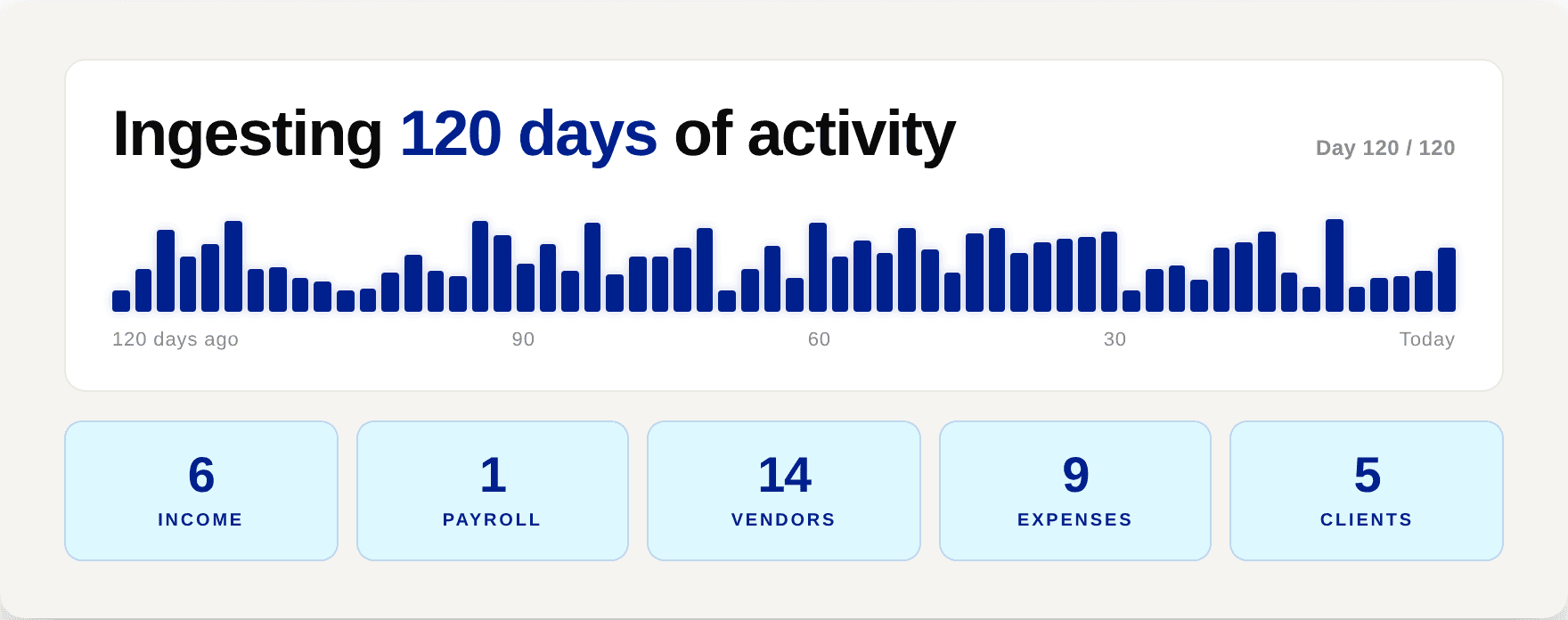
The user authenticates into each tool. Agents navigate. Deterministic code writes the account and routing numbers. The most common updates on Gusto, Stripe, Square, and 30+ others finish in under 30 seconds. We automate what we can and guide what we cannot.
The embedded SDK deploys inside your banking product in three to five days. The hosted flow requires zero engineering to start. Both are white-labeled.
Early results
One user moved $3.5M and 7 tools in under 15 minutes.
Another moved $4.2M and 27 tools.
Lettuce has migrated thousands of accounts, moved millions of dollars, and seen over 80% of users who begin the flow complete it.
We cleared full InfoSec, Risk, and Legal diligence at a $40 billion financial institution in under six months.
What's next
The next decade of business banking goes to the institutions that turn opened accounts into primary relationships. The capability to do that at scale exists now.
If you're a bank or fintech and account opening is outpacing activation, we should talk.